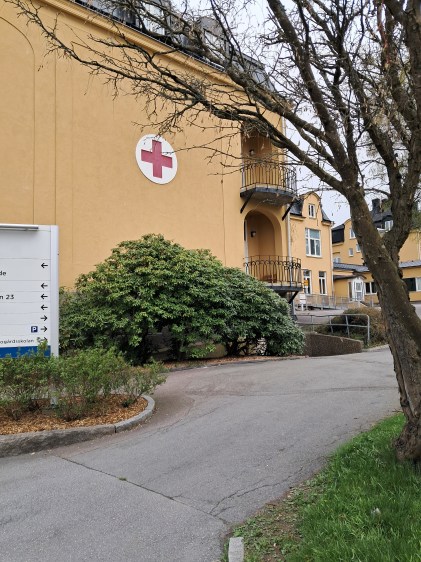
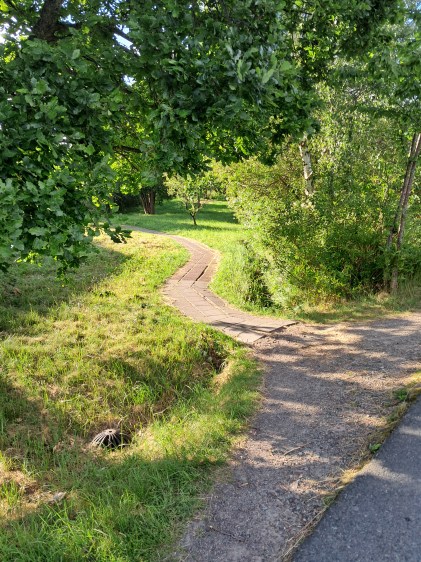
It have meant a lot to me to “show” Elisabeth Punzi Lillhagen, (and later Abdelhamid). That she too her time to go around with me and look at the place, the different buildings with their numbers. What had been the kiosque at the area, the surrounding forest and “Rödberget”, a name I learned only a few weeks after we had been around together. I wanted to show her the old water cistern, but I didn’t find the to way around to it. I think I was a little nervous showing Elisabeth around. A role I never could had imagined myself in.
Instead, we ended up at Bagar- och Bykstugan. It was bought by former employees at Lillhagen who went together in a n organization. They meet every month and most of them live in the area.
I was there in the evening in November last year. A fire was lit and it was warm and cosy. It is not often one is in such old houses nowadays with a history one can trace back to the 14th century.
One of the woman who worked at Lillhagen told me that she struggle during a long time to get a lift to the bath. She had a patient that really wanted to take a bath and the personal was also tired of getting wet on when they were showering the patients. The patients were heavy. Eventually, she acquired the lift, allowing them to move the patients up and down from the bath with greater ease. Her supervisor said to her with cider.
Another former employee told me about the time when the neuroleptic revolution came to the hospital.
“When was that?” I asked.
I think it was during the Korean war. It was that association that first came to her mind: The beginning of the 1950`s and the Cold war. The Korean war started in 1953. It was a time when the psychatrists didnt need to have official approval of the experiments they carried out on their patients. One former nurse said though that when Hibernal came she marvelled because that psycofarmic drug got the patients up from their beds. Before they had just been laying in bed 7/24.
The evening had I visited the Bagar-and Bykstuga had a subject, it was an employee high up in the administration who lectured about the sculptures at Lillhagen, mostly the absent one because all the precious sculptures in bronze had disappeared long ago. One suspect it to be thiefs who have taken them because of the high price on bronze. We looked at pictures of the sculptures and there was a lively discussion about artists and the names of the sculptures and memories connected to them.
The woman who talked about neuroleptics remembered one of the artists who was hospitalized at Lillhagen several times because of his dependence on alcohol. She spoke about a painting he had given to the dayroom. I heard some anecdotes, some numbers on the wards and I could detect sorrow and longing in their voices. Det här om nostalgi. Gruvarbatearna. They talked about how Lillhagen for many patients was their home, they had no other. It was their destination. Others they could came back and visit the employees and sit down for a while – pay visits like this.
I myself remember one old woman coming to a mental hospital I was patient at. She was like an old relic: the nurse told me that she came every day to look after and water the flowers, I looked at her and wondered if it was the future me I saw in her as she shuffled around with a water can in her hand? I have seen so many different persons at the psychiatric hospitals. I have seen the catatonic schizophrenics, I have seen the young mother who minutes before had had ECT, and I was frightened that a psychiatrist would come up with the idea that I somehow needed that treatment. I could see the change in her, how she became limp, like without personality y. At the same time, I could ask myself`? Did others look at me the same way.
You don’t only become docile you became humble, the psychiatric hospital teaches you something one hardly can learn at some other place; but that it is difficult to dress in words. Therefore, I am happy that researchers like Elisabeth Punzi Hansen start to look at the experiences patients have and have had through the years at mental hospitals. Surveillance. Places of surveillance, shame and incarceration. Ha trip to the mental hospital and look at the mad people, dårarna (in Swedish).
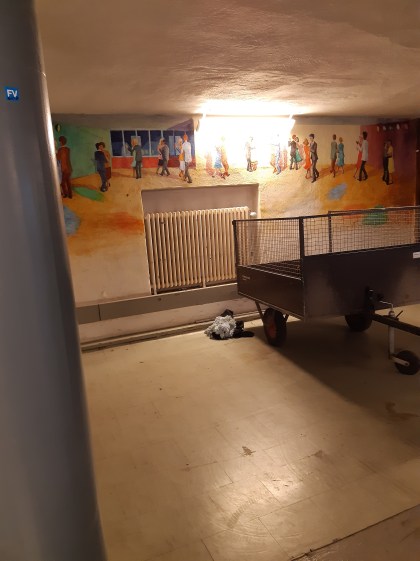
I really appreciated talking to Stefan whom I met during walking around with Elisabeth Hansen. I remembered his collegue vaguely. He showed me were the emergency intake was. We were in the tunnels underneath. Elisabeth was showing me the art. I remembered it. Especially the forest of birch trees. It was close to the way to the emergency intake. I realized how much compassion and understanding he had. It was fantastic. It was fantastic and see and feel what I couldn’t see or feel with so much neuroleptics in my body. Not that I am entirely free of it; I have medicine at need. But since I have started to go to psychologist I have started to understand more of myself. I have talked to Elisabeth how much my psychologist at PNO means to me, and if it is something I really want to convey is it that the “talking cure” I s the revolution, not the neuroleptic. Unfortunately, there is scarcity when it comes to psychologist and I suspect there had been, and still is, difficult to get a psychologist to talk to at all. Some patients are considered unfit for the talking cure, and it is mainly because they get so much neuroleptics that they cannot talk. I have ben in that place myself. And what I understand it is also common knowledge (conveyed by curator Birgitta Elmqvist) that patients on heavy dozes medicine just don’t benefit from talks.
I met Elisabeth at the conference in the beginning of June 2019 and I started to feel that I could start to tell my story. My old psychologist had gone in pension but I hade already got one and felt confident. Elisabeth told me that it is important that people like me, the mad people “, write their own history. That it means much for identity and so on. I was at the conference two thirds of the day, then I had to go. A performance from an old hospital building was just too strong to see. I couldn’t see it to the end. The movements she did, like a metamorphose, remembered me of how it was when getting Haldol injected. It was just like that.
My friends and I belong to small group, Talbart in Swedish, it means Talkable. We have also a blog. It was through our leader, a teacher at the university who asked us if we would like to come to the heritage conference in the first place. (This “small group” dissolved in 2020).
It was amazing. The atmosphere of kindness and openness. Nevertheless, to hear the lecturers talk about a world that I thought no one was interested and in principle was inexplicable (obegriplig in Swedish) was even more amazing. That they could put words on things I had experienced but couldn’t but couldn’t put in language, couldn’t communicate. Then to get an invitation myself to get involved in this way was an opportunity I felt ready to grasp.
My trauma was not resolved at the hospital. It got worsened and I was retraumatized the same day I arrived. What brought me to the hospital in the first place was “violations” (övergrepp på svenska) I have talked about elsewhereI, which I suffered during a half year stay in Asia. No one had a clue of what I had undergone or what was suppressed inside me. No one understood or asked. Instead one thought I had been taking drugs and my parents thought I hade become member in a sect. And the years went by. Until I trusted a curator after many years of appointments with her, and started to talk and thus prepared the ground for psychological treatment (at least what I thought). Now my psychologist says that if I only had had a person I could have talked to when I came home from Asia, instead of quite soon being told I was worshipping the devil. Matters could have looked a whole lot different, in hindsight. Men som kristen (jag har återvänt till min barndomstro) måste jag tro att Gud har en plan med mitt liv, såväl med allas liv.